
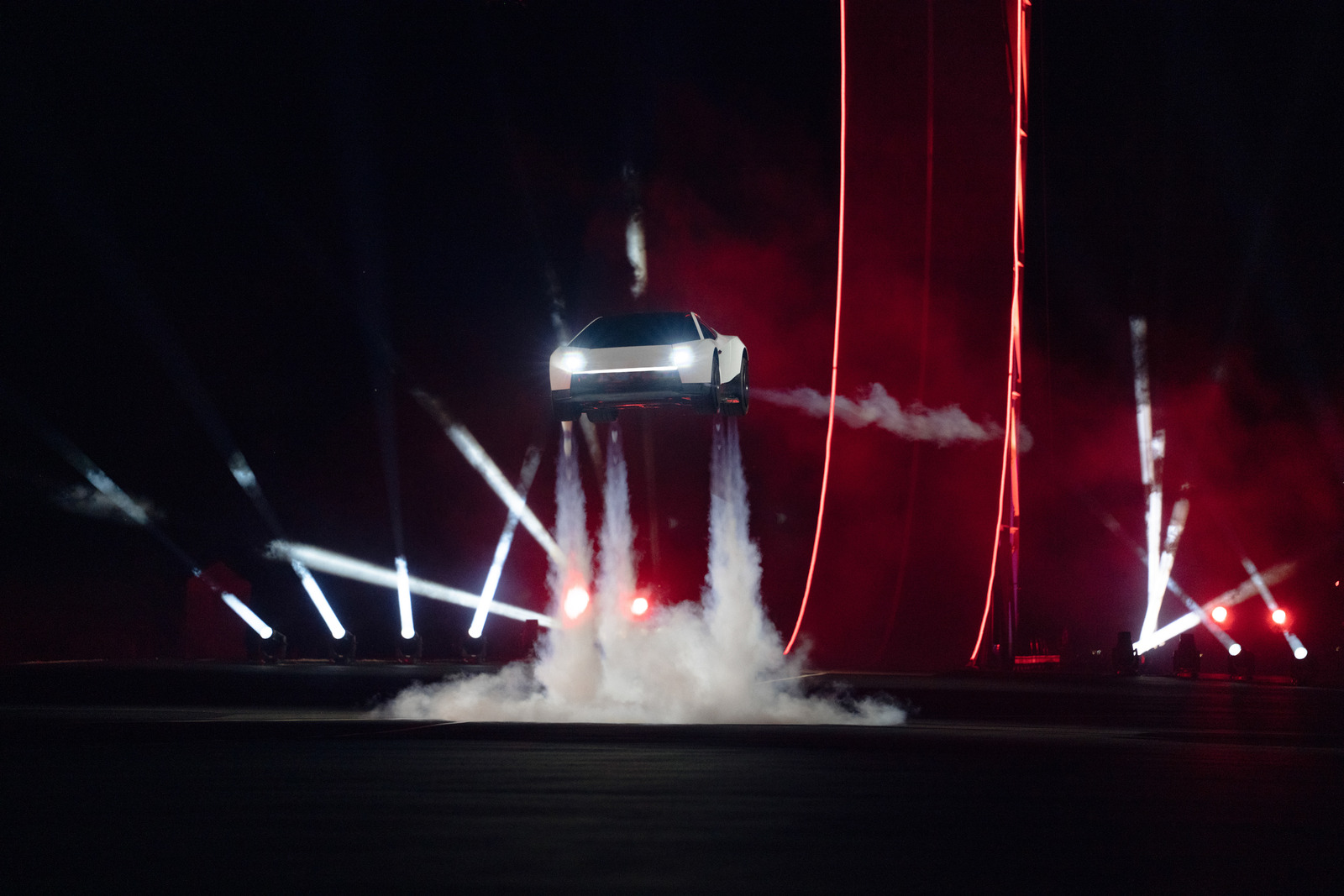
On October 15, 2026, Tesla demonstrated its next-generation Roadster performing maneuvers that most people would ordinarily associate with aerospace vehicles rather than automobiles. The demonstration included driving along an inverted structure, maneuvering in the air, and jumping over a series of parked vehicles.
I found the demonstration fascinating because of the engineering relationships involved.
We have spent decades developing technologies capable of controlling the position, orientation, and trajectory of vehicles operating in environments where conventional mechanical contact or aerodynamic surfaces provide insufficient control.
Spacecraft use reaction-control systems to adjust orientation and trajectory. Experimental vertical-takeoff aircraft use carefully controlled thrust to maintain stability. Robotics employs combinations of sensors, mathematical models, and actuators to control motion through complex environments.
Now we're seeing several of these technologies integrated into a high-performance automobile.
The possibilities extend considerably beyond making a car jump.
From the Flying Bedstead to Spacecraft Reaction Control
Some of the earliest experiments in powered vertical flight provide a useful starting point.
During the 1950s, Rolls-Royce developed the Thrust Measuring Rig, commonly called the Flying Bedstead. It was an experimental aircraft designed to study vertical lift and attitude control using jet thrust.
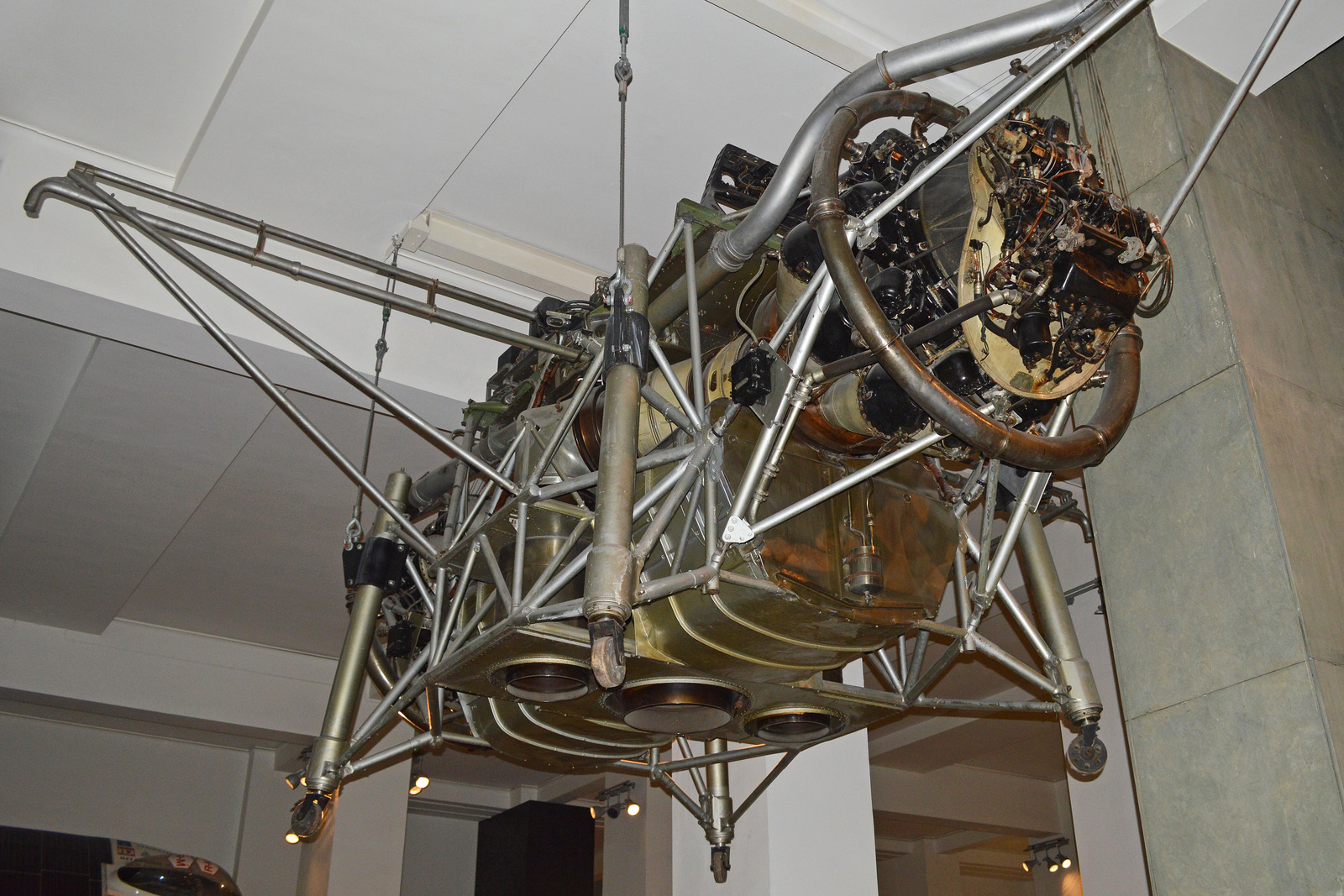

Its configuration was unconventional because the aircraft could generate lift and maintain orientation without relying on forward velocity to produce aerodynamic lift over conventional wings.
The vehicle's motion could be controlled through the application of forces at different locations and orientations.
NASA subsequently developed its Lunar Landing Research Vehicles and Lunar Landing Training Vehicles to investigate and reproduce aspects of lunar landing dynamics.
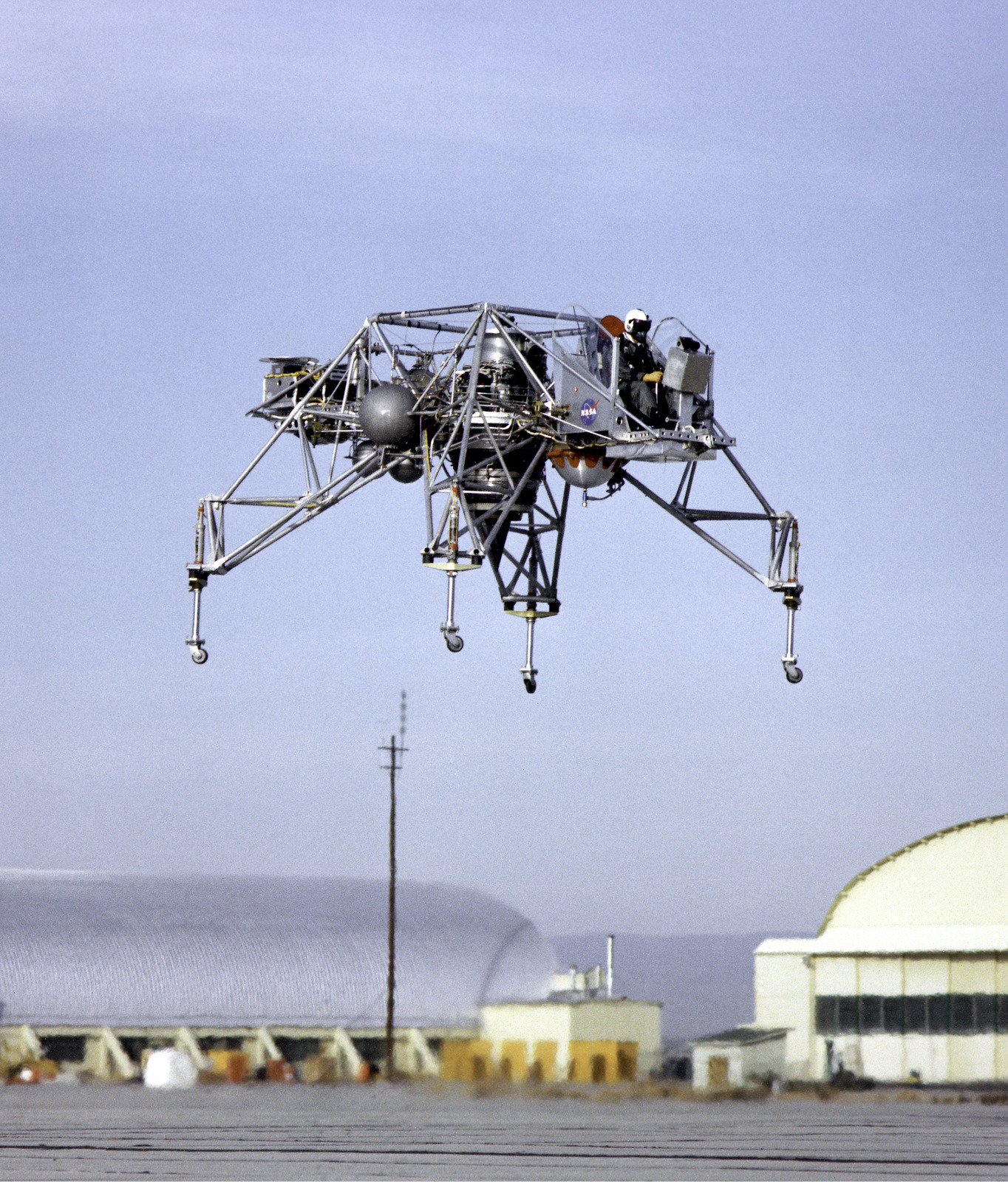

These experimental systems explored a fundamental engineering problem: how to control a vehicle's motion when its relationship with gravity, thrust, and the surrounding environment differs substantially from that of a conventional aircraft.
The same mechanics appear in spacecraft reaction-control systems.
When a spacecraft approaches another vehicle or prepares to dock with the International Space Station, its control system must manage relative position, velocity, orientation, and angular momentum.
Small, precisely directed impulses can change the spacecraft's translational motion or rotate it around one or more axes.
Those impulses are described through ordinary force mechanics.
Newton's second law gives us:
Force equals mass multiplied by acceleration.
For multiple forces acting simultaneously, the resulting acceleration follows the vector sum:
The direction, magnitude, and duration of the individual forces determine how the vehicle's motion changes.
A force applied away from the vehicle's center of mass also produces a torque:
Here, represents the vector from the center of mass to the point where the force acts.
By selecting where and when forces are applied, a controller can influence translation and rotation independently or in combination.
This is the underlying relationship I see between spacecraft maneuvering and the new Roadster.
A vehicle equipped with several independently controllable reaction thrusters gains additional means of changing its trajectory and orientation.
For an automobile, that control must be integrated with tire forces, suspension behavior, aerodynamics, road geometry, and the changing relationship between the vehicle and the surface beneath it.
The mechanics already have an extensive history in aerospace engineering. Integrating them into an automobile introduces another operating environment in which those principles can be applied.
A Personal Connection to the International Space Station
My interest in these systems also comes from a personal experience involving my father.
When my father was studying for his astronaut certificate in connection with the International Space Station motion-control group, he showed me a software system called BEV.
I remembered the visualization for years.
BEV stood for Bird's Eye View, and NASA documented the Motion Control System BEV application in a 2002 technical paper by Adam Dershowitz and Gregory Chamitoff.
The software provided a three-dimensional representation of the International Space Station using actual telemetry.
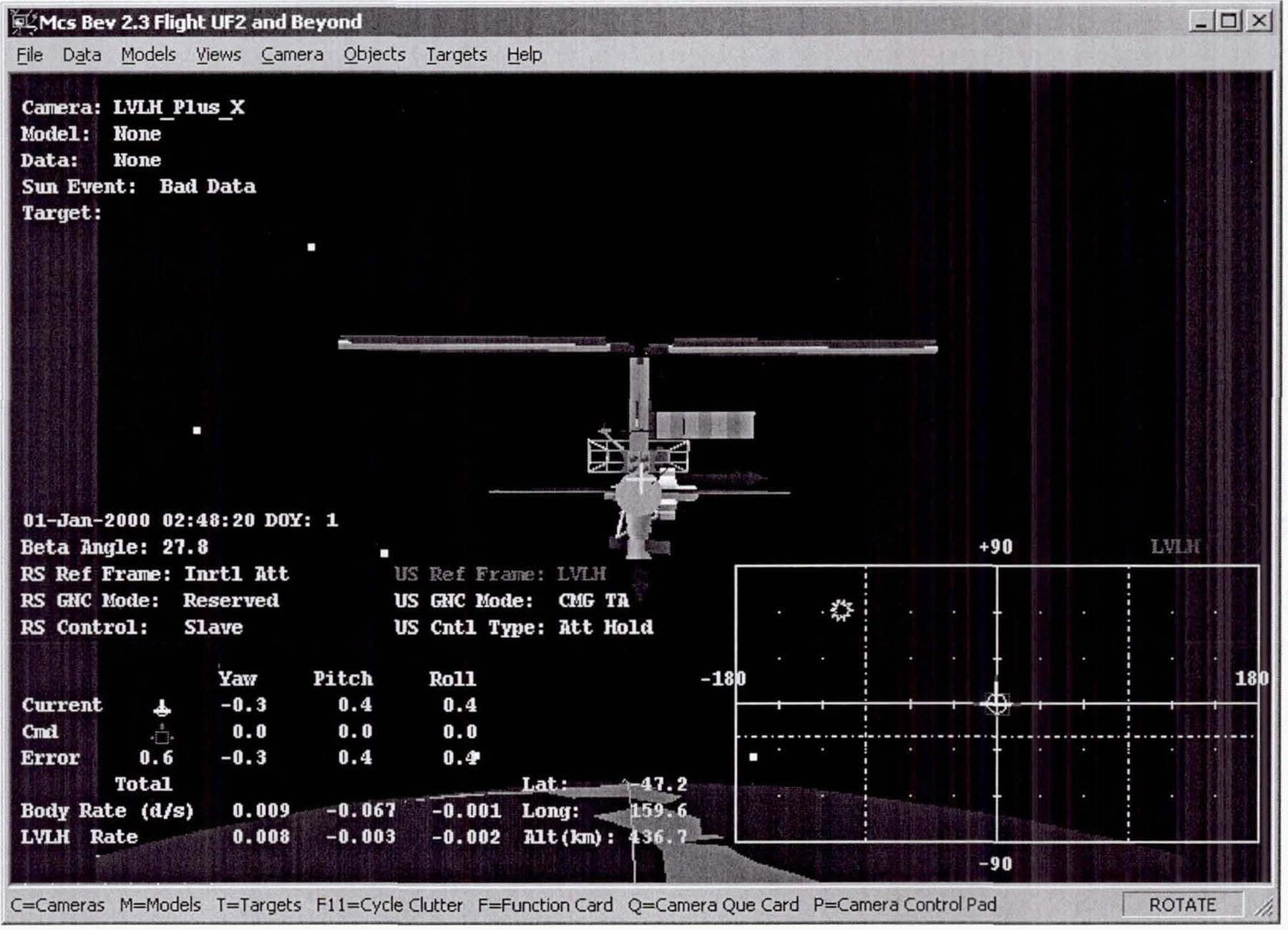
It allowed operators to examine the station's orientation, position, configuration, and relationships to other objects through a virtual camera that could move around the spacecraft.
The visualization could represent the station relative to Earth, the Sun, selected targets, and different coordinate reference frames.
One of the remarkable aspects of that software was the ability to observe a complicated physical system from perspectives that would otherwise be inaccessible.
The underlying technology originated in robotics training before evolving into a spacecraft motion-control visualization system.
I've spent much of my career working with interactive multimedia, software systems, simulation, and artificial intelligence. Seeing these technologies applied to spacecraft motion was a natural extension of the engineering problems that interested me.
A mathematical simulation allows us to represent the physical state of a system, calculate how forces influence that state, and examine possible future trajectories.
When connected to sensors and telemetry, the model can be continually corrected against the actual system.
The relationship between simulation and physical control becomes especially powerful when the controller can evaluate several possible actions before selecting one.
That brings us directly to the vehicle Tesla demonstrated.
Combining Reaction Thrusters with Aerodynamic Control
The Roadster demonstration incorporated two particularly interesting technologies: high-pressure gas thrusters and an electrically driven suction system.
Tesla engineering discussions describe a configuration using high-pressure gas stored in carbon-composite vessels, with multiple thrusters capable of delivering substantial bursts of force.
The reported suction system includes four electrically driven fans, each rated at approximately 20 kilowatts, giving a combined nominal motor rating of roughly 80 kilowatts.
The fans remove air from beneath the vehicle, generating a pressure differential between the underside of the car and the surrounding atmosphere.
The resulting force can increase the load carried by the tires, allowing greater traction under appropriate operating conditions.
We have seen similar principles applied in motorsport.
The Chaparral 2J and Brabham BT46B used fan-generated airflow to influence vehicle downforce.
Related pressure-differential systems have also appeared in wall-climbing robots and industrial inspection equipment, where adhesion permits machines to operate on surfaces beyond the capabilities of conventional wheeled platforms.
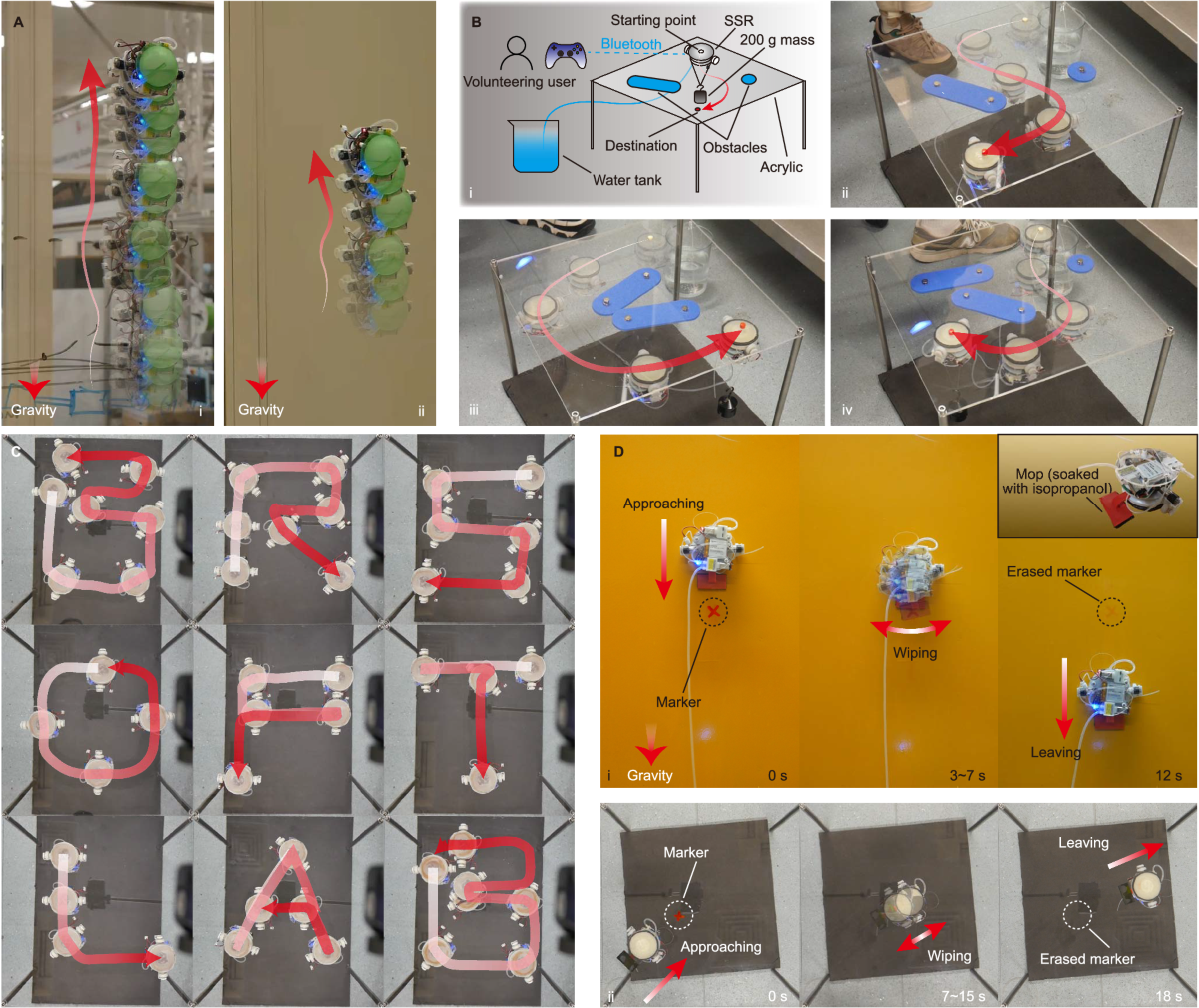
What becomes especially interesting is combining pressure-based adhesion with controllable reaction forces.
The suction system can increase the vehicle's contact force against the road.
The thrusters can provide additional forces along selected directions.
A sufficiently sophisticated controller can coordinate those systems with conventional steering, braking, suspension, and electric drivetrain controls.
The combination gives the vehicle more control inputs than an ordinary automobile possesses.
The engineering question then becomes how to allocate those forces to produce the desired trajectory while maintaining stability and managing the available energy.
Reversible Airflow and Multifunctional Engineering
There's another possibility I would investigate in the design architecture.
If we're already using powerful electric motors to move substantial volumes of air through a controlled flow path, why limit that architecture to producing suction beneath the vehicle?
An appropriately designed air-handling system could potentially perform several different functions.
During ordinary driving, the fans might operate to establish low pressure beneath the chassis, increasing the effective load on the tires.
Under another operating condition, the controller could redirect or reverse airflow to produce a different force distribution.
Suppose the vehicle needs to temporarily reduce contact with the road surface, or even separate from it for a very short period.
A system that can redirect a sufficient mass flow could contribute an upward reaction force by accelerating air downward.
The relationship follows conservation of momentum.
For a simplified flow, the approximate thrust contribution can be expressed as:
Here, is the mass flow rate and is the change in velocity imparted to the moving air.
Pressure forces at the boundaries of the flow path may also contribute to the resulting force.
The mass flow rate can be expressed as:
Where is air density and is volumetric flow rate.
These relationships give us the foundation for evaluating a reversible or redirected-flow architecture.
We would need to examine the fan characteristics, motor capacity, duct geometry, inlet and outlet orientation, available pressure differential, and the losses associated with each flow configuration.
Reversing the rotational direction of an existing fan is only one possible implementation. A system designed from the beginning for multiple operating modes could instead use adjustable flow paths, valves, variable-pitch impellers, or other mechanisms to direct airflow according to the desired force.
The objective would be to determine whether the air-moving hardware could produce useful force in more than one direction without requiring a separate, entirely independent propulsion system for every operating mode.
The existing electric motor and power electronics could potentially serve several functions, although the suitability of shared mechanical components would depend on their design and operating requirements.
Tesla's reported use of motors related to its heat-pump compressor family makes the subject of electromechanical integration particularly interesting.
A separate engineering question concerns replenishing stored high-pressure gas.
The suction fans and the pressure-storage system operate across substantially different pressure regimes. A practical replenishment system could use dedicated compression stages while sharing selected electrical, thermal, or control infrastructure.
Those are design choices that can be investigated quantitatively.
The broader opportunity is a multifunctional vehicle architecture in which individual components contribute to several modes of operation.
Impulse, Duration, and Vehicle Maneuverability
Following the Roadster demonstration, Yann LeCun and Elon Musk exchanged remarks about the physics of compressed-gas propulsion.
Compressed gas has limitations as a source of sustained propulsion because the vehicle must carry its reaction mass.
That establishes a finite resource for the thrusters.
However, the engineering requirements change considerably when we examine brief, controlled impulses rather than continuous thrust-supported flight.
The relevant mechanical quantity is impulse:
Impulse represents the change in momentum produced by a force applied over time.
For a vehicle of constant mass, the corresponding velocity change can be approximated as:
A brief impulse applied in the correct direction can change a vehicle's trajectory.
A series of controlled impulses can influence translational movement or angular orientation.
The timing and direction of each impulse determine how effectively it contributes to the desired motion.
This suggests a distinction between maintaining an automobile in sustained flight and providing short-duration maneuvering authority.
Consider a vehicle approaching a condition where available tire traction is insufficient to maintain its intended trajectory.
Conventional stability control can reduce drivetrain torque and apply braking forces to individual wheels.
An additional actuator capable of applying a directional force may provide another means of changing the vehicle's motion.
The controller would have to determine whether that additional force improves the available recovery options.
Likewise, during a short airborne maneuver, reaction thrusters could influence the vehicle's angular orientation and landing trajectory.
The operating objective determines the amount of impulse required.
For a controller designed around intermittent corrections, the total gas consumption depends on the magnitude, frequency, and duration of those corrections.
This is a different engineering allocation problem from designing a vehicle to remain continuously airborne.
Traction, Curvature, and Predictive Control
Consider what happens when a vehicle enters a turn.
The lateral force required to follow a circular trajectory can be approximated by:
Where:
- is vehicle mass,
- is velocity,
- is the radius of the turn.
For a fixed turn radius, doubling the velocity requires four times the lateral force.
The tires must generate that force through their interaction with the road.
A simplified estimate of the available tire-force limit is:
Where represents an effective friction coefficient and represents the total normal load.
The available traction changes with road surface, water, dust, temperature, tire condition, loading, and numerous other variables.
An active suction system can increase normal loading while the vehicle remains coupled to a suitable surface.
On approximately level ground, a simplified vertical force balance during road contact is:
Here, represents additional downward force and represents an upward force from another actuator.
This equation also illustrates why the controller must distinguish between operating modes.
Increasing downward force can improve the available tire traction under suitable conditions.
Applying upward force reduces the normal load carried by the tires.
Those different force allocations serve different maneuvering objectives.
A controller might prioritize suction during high-speed cornering, while a separately defined maneuver could require reducing road contact or controlling motion after the wheels have left the surface.
The system must calculate the appropriate combination rather than treating every available actuator as something that should be activated simultaneously.
I would approach that problem through predictive modeling.
Once the driver selects a route, the vehicle could begin constructing a continuously updated representation of the roadway.
The model would include curvature, elevation, braking zones, surface conditions, expected velocity, and locations where a recovery trajectory might be available.
As the vehicle travels, onboard sensors would update the model using wheel speeds, steering input, yaw rate, acceleration, tire slip, suspension response, and observations of the surrounding environment.
The controller could continually compare the current vehicle state with predicted future states.
It would evaluate whether the intended trajectory remains within the available operating envelope.
When the model identifies an approaching traction limit, the controller could determine whether reducing speed, adjusting motor torque, applying braking, changing downforce, or allocating a reaction impulse would provide the best available response.
This creates a relationship between route planning, physical simulation, and real-time control.
The vehicle would be making decisions based on an evolving representation of the forces acting upon it and the trajectories available from its present state.
The objective is to preserve controllability and increase the range of recoverable operating conditions.
How I Would Test the Architecture
I would begin with an instrumented vehicle operating on a controlled test course.
The initial testing would characterize the conventional mechanical capabilities of the vehicle, including steering response, braking, traction limits, and suspension behavior.
Those measurements would establish a baseline.
Next, I would enable the suction system and repeat selected maneuvers under controlled conditions.
The testing would include variations in surface moisture, available friction, road curvature, and introduced particulate material.
The purpose would be to measure how the additional downforce changes the vehicle's available maneuvering envelope.
I would also evaluate the controller's ability to predict those changes from its sensor data.
A useful test would compare the predicted available traction against the actual measured response of the vehicle.
The differences between prediction and observation could then be used to improve the model.
Once the suction system had been characterized, I would introduce carefully bounded reaction-thruster interventions.
These tests would measure the relationship between commanded impulse, resulting trajectory change, actuator response time, vehicle orientation, and remaining reaction mass.
The tests would initially be conducted without a human occupant, using controlled conditions and physical containment appropriate to the maneuver.
The controller would also need to demonstrate how it behaves when individual sensors or actuators become unavailable.
A failure in one component should be evaluated in terms of how it changes the remaining controllable operating envelope.
The comparison I would ultimately want to see is straightforward.
Run the same vehicle through a defined maneuver using conventional controls.
Repeat it with the suction system enabled.
Then evaluate whether adding appropriately directed reaction impulses produces a measurable improvement in trajectory control or recovery capability.
The results should include the energy consumption, response time, operating limitations, and repeatability of each configuration.
We could determine which combinations actually improve performance and under what conditions.
The resulting data would be useful for both automotive engineering and the broader development of intelligent physical control systems.
Beyond the Roadster: Robotics and Extraterrestrial Vehicles
The technologies represented by the Roadster also suggest applications beyond conventional transportation.
Reaction-control systems, autonomous navigation, physical simulation, and predictive motion control are already important elements of spacecraft and robotic systems.
The relationship becomes particularly interesting when we consider vehicles operating under unusual gravitational and environmental conditions.
A lunar surface vehicle, for example, must account for reduced gravity, difficult terrain, limited traction, and the absence of atmospheric aerodynamic forces.
A vehicle operating on Mars encounters another combination of gravitational, atmospheric, and terrain conditions.
Near an asteroid or another small celestial body, the available gravitational force may be extremely small compared with the reaction forces generated by the vehicle's own actuators.
The physical operating environment changes, and the design of the propulsion and traction systems changes with it.
The mathematical control architecture can retain many of the same fundamental relationships.
A controller representing vehicle mass, orientation, velocity, available forces, and predicted trajectories can be adapted to different environments through the corresponding physical models.
For a terrestrial automobile, the control problem may involve tire adhesion, aerodynamic forces, and limited airborne maneuvers.
For a lunar robotic vehicle, the problem may involve wheel traction, terrain geometry, reduced gravity, and reaction-assisted stabilization.
For a spacecraft, the controller may primarily allocate thrust to manage translation and rotation.
The relationships between force, momentum, torque, and motion remain available across these applications.
One of the opportunities I see is developing increasingly general control architectures that can be adapted to different physical systems.
As the hardware becomes more capable, the software can coordinate a wider variety of actuators and operating modes.
And as simulation improves, we can evaluate more of those interactions before attempting them with physical hardware.
That takes us back to the importance of the visualization and simulation systems I encountered through my father's work with BEV.
We are continuing to develop the relationship between mathematical representations of physical systems and the machinery those representations help us control.
Composite Manufacturing and the Difference Between a Prototype and a Product
Another aspect of the Roadster that interests me is the manufacturing technology.
I recently had a discussion with Robert Scoble involving composite aircraft manufacturing.
I was discussing the fabrication of aircraft wings using composite materials, while part of the response concerned aircraft fuselage construction.
The distinction is relevant because the geometry, structural loading, fabrication methods, and design objectives can differ considerably between wings and fuselage structures.
I have practical experience working with fiberglass, epoxy resin, and composite fabrication.
In the early 1990s, I worked with model sailboats, including a Marblehead-class sailboat project, using resin, fiberglass, fillers, and related finishing processes.
These experiences gave me an appreciation for the relationship between material properties, molds, structural geometry, and fabrication techniques.
Composite fabrication allows engineers to create complex shapes while controlling material placement, structural reinforcement, and weight.
Vacuum-assisted processes can help consolidate layers of composite material and improve manufacturing consistency.
The engineering becomes especially interesting when we move from producing an individual structure to manufacturing large numbers of highly consistent components.
An experimental aircraft or prototype vehicle can be built through an extensive process of custom fabrication, fitting, testing, and adjustment.
A commercial manufacturer must reproduce its components with controlled tolerances, documented processes, maintainable systems, and predictable material properties.
The Roadster's reported use of carbon-composite pressure vessels illustrates the convergence of advanced materials and aerospace-related technologies.
The challenges include pressure containment, fatigue behavior, inspection, thermal conditions, and manufacturing consistency.
Similar manufacturing questions arise with structural composite components, electromechanical actuators, and integrated thermal systems.
As these technologies enter repeatable manufacturing processes, the accumulated production experience can support further engineering development.
The industrial capability itself becomes an asset.
High-Technology Abundance
I've discussed the concept of technological abundance in other contexts, and I think it applies here.
A technology demonstrated in a laboratory establishes that a particular capability can be achieved under specified conditions.
Developing that technology into a reproducible product creates additional possibilities.
More engineers can examine it.
Manufacturing processes can be refined.
Component designs can evolve through repeated production.
Maintenance requirements become better understood.
Software can be updated against a growing body of operational experience.
Suppliers can develop specialized manufacturing capabilities around components that were previously produced only for isolated projects.
An expensive first-generation product can establish manufacturing knowledge that later contributes to more accessible technologies.
We've seen versions of this progression throughout the history of computing, electronics, robotics, aerospace systems, and automotive engineering.
The ability to reproduce a sophisticated machine changes the range of experiments, applications, and subsequent inventions that become economically practical.
If Tesla can move these integrated vehicle systems from a spectacular prototype into repeatable production, the engineering consequences may extend into other industries.
The development of advanced electromechanical systems, composite structures, sensing architectures, and intelligent controllers contributes to a broader industrial foundation.
That foundation can support applications beyond the product that initially justified its development.
Artificial Intelligence and the Next Generation of Vehicles
Elon Musk has also discussed the possibility of increasingly sophisticated intelligence being integrated into the Roadster.
The suggestion of a sentient vehicle opens a much larger discussion about artificial intelligence and its relationship with physical machinery.
I've been interested in artificial intelligence since the 1990s, particularly the ways information processing, learning, simulation, and adaptive behavior can be integrated into complex systems.
A vehicle equipped with advanced sensing, predictive models, and multiple independent means of controlling physical motion presents an interesting environment for developing embodied intelligence.
The system could maintain a continually updated representation of its own physical condition.
It could track changes in tire performance, actuator availability, pressure storage, temperature, mechanical wear, and the surrounding environment.
It could compare predicted outcomes with actual outcomes and use the resulting differences to improve its control models.
The vehicle could also learn relationships between roadway characteristics and the forces required to maintain particular trajectories.
With sufficient computational capability, it could evaluate multiple possible maneuvers and select actions according to the physical constraints of the moment.
This is where artificial intelligence becomes directly connected to the mechanical capabilities of the vehicle.
The system can only influence the physical world through the actuators available to it.
Adding controllable force systems expands the set of actions that the intelligence can evaluate and perform.
In turn, increasingly capable intelligence can coordinate combinations of actuators that would be difficult for a human operator to manage individually.
The relationship is reciprocal.
The mechanical architecture provides the available degrees of control, while the intelligence determines how those controls can be allocated toward particular objectives.
The development of such systems also creates opportunities for studying how machines build representations of their own physical state and maintain those representations as their operating conditions change.
I expect the convergence of artificial intelligence and advanced physical control to become increasingly important across robotics, transportation, manufacturing, and aerospace engineering.
Where the Engineering Leads
The Roadster demonstration gives us a glimpse of what becomes possible when technologies developed in different engineering disciplines are brought together.
The reaction-control principles have decades of history in aerospace applications.
Fan-generated pressure differentials have been investigated in motorsport and robotics.
Composite manufacturing has evolved through decades of work in aviation, marine engineering, aerospace, and industrial production.
Predictive control and artificial intelligence provide additional ways to coordinate these technologies.
Integrating them into an automobile creates new questions concerning force allocation, energy consumption, control authority, component design, and manufacturing.
I would particularly like to see further experimentation with multifunctional airflow architectures and the relationship between suction, redirected airflow, and reaction-assisted maneuvering.
There are also substantial opportunities to improve vehicle safety through predictive models that understand approaching traction limits and determine the available recovery options.
A carefully instrumented testing program could establish which capabilities improve vehicle control and how those improvements vary under different operating conditions.
The same engineering knowledge can contribute to the development of robotic and extraterrestrial vehicles.
And if these systems become commercially reproducible, their underlying technologies become available for further development across a much larger engineering community.
The Roadster is an unusual automobile, but I see something much broader in the combination of technologies it represents.
We are bringing together physical simulation, intelligent control, advanced materials, and multiple means of applying forces to complex moving systems.
Those relationships have been developing across aerospace, robotics, and computing for generations.
Now we're beginning to see them converge in machines that people may eventually be able to own, operate, and improve.
I find that prospect considerably more exciting than the question of how long a car can remain in the air.